| Aeroscraft |
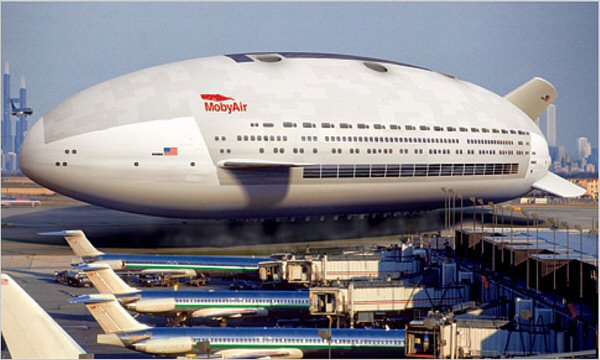 Even though the Aeroscraft dwarfs the largest commercial airliners, it
requires less net space on the ground than any plane because it doesn’t need a
runway. The airship takes off and lands like a helicopter: straight up and
down.
This is not a Blimp. It’s a sort of flying Queen Mary 2 that could
change the way you think about air travel. It’s the Aeroscraft, and when
it’s completed, it will ferry pampered passengers across continents and oceans
as they stroll leisurely about the one-acre cabin or relax in their
well-appointed staterooms.
Unlike its dirigible ancestors, the Aeroscraft is not lighter than
air. Its 14 million cubic feet of helium hoist only two-thirds of the
craft’s weight.
The rigid and surprisingly aerodynamic body - driven by huge rearward propellers - generates enough additional lift to keep the behemoth and its 400-ton payload aloft while cruising. During takeoff and landing, six turbofan jet engines push the ship up or ease its descent. This two football-fields-long concept airship is the brainchild of Igor
Pasternak, whose privately funded California firm, Worldwide Aeros Corporation,
is in the early stages of developing a prototype and expects to have one
completed by 2010. Pasternak says several cruise ship companies have
expressed interest in the project, and for good reason: The craft would have a
range of several thousand miles and, with an estimated top speed of 174 mph,
could traverse the continental U.S. in about 18 hours. During the
flight, passengers would peer at national landmarks just 8,000 feet below or, if
they weren’t captivated by the view, the cavernous interior would easily
accommodate such amenities as luxury staterooms, restaurants, even a casino.
To minimize noise, the aft-mounted propellers will be electric, powered by
a renewable source such as hydrogen fuel cells. A sophisticated
buoyancy-management system will serve the same purpose as trim on an airplane,
allowing for precise adjustments in flight dynamics to compensate for outside
conditions and passenger movement. The automated system will draw outside
air into compartments throughout the ship and compress it to manage onboard
weight.
On a pressurized plane, windows like these would explode outward. The Aeroscraft does not fly high enough to need pressurization. The company envisions a cargo-carrying version that could deliver a store’s
worth of merchandise from a centralized distribution center straight to a
Wal-Mart parking lot or, because the helium-filled craft will float, a year’s
worth of supplies to an offshore oil rig. “You can land on the snow, you
can land on the water,” Pasternak says. “It’s a new vision of what can be
done in the air.” |